
JSEEGT Logo

Journal of Sustainable Energy Environment and Green Technologies

Mitigating Renewable Power Fluctuations through Adaptive Predictive Control for Grid Stability Enhancement

Document Type : Original Research Article
Received: 18 June 2026 | Revised: 08 July 2026 | Accepted: 20 July 2026 | Published: 28 July 2026

Authors

1 Independent Researcher
* Author to whom correspondence should be addressed.

Abstract

The fast adoption of renewable sources such as solar and wind energy increases sustainability in electricity generation in modern smart grids but leads to problems related to intermittency, power fluctuation, voltage instabilities, frequency changes and power imbalance that may impact the reliability and resilience of the grid. In order to solve these problems, the research proposed an Adaptive Predictive Renewable Stability Network (APRSN), which is an intelligent system for renewable energy management and increased grid stability. The APRSN integrates renewable power prediction, Adaptive Predictive Control (APC), Renewable Stability Index (RSI) based grid stability evaluation, Battery Energy Storage System (BESS) coordination and adaptive optimization into one system. APRSN constantly analyzes the information on renewable generation, demand, voltage, frequency, weather and battery states to predict the future state of the grid, evaluate its stability and take necessary control actions. The BESS coordination takes place depending on power imbalances in order to store extra renewable power and used the grid with generation deficit. The experimental evaluation of APRSN showed 99.1% accuracy of forecasting along with the improved voltage and frequency stability, reduction of renewable power fluctuations and higher renewable energy utilization and strengthening grid resilience. The results demonstrate the potential of APRSN as an integrated approach for reliable renewable-energy management in smart-grid environments.

Graphical Abstract
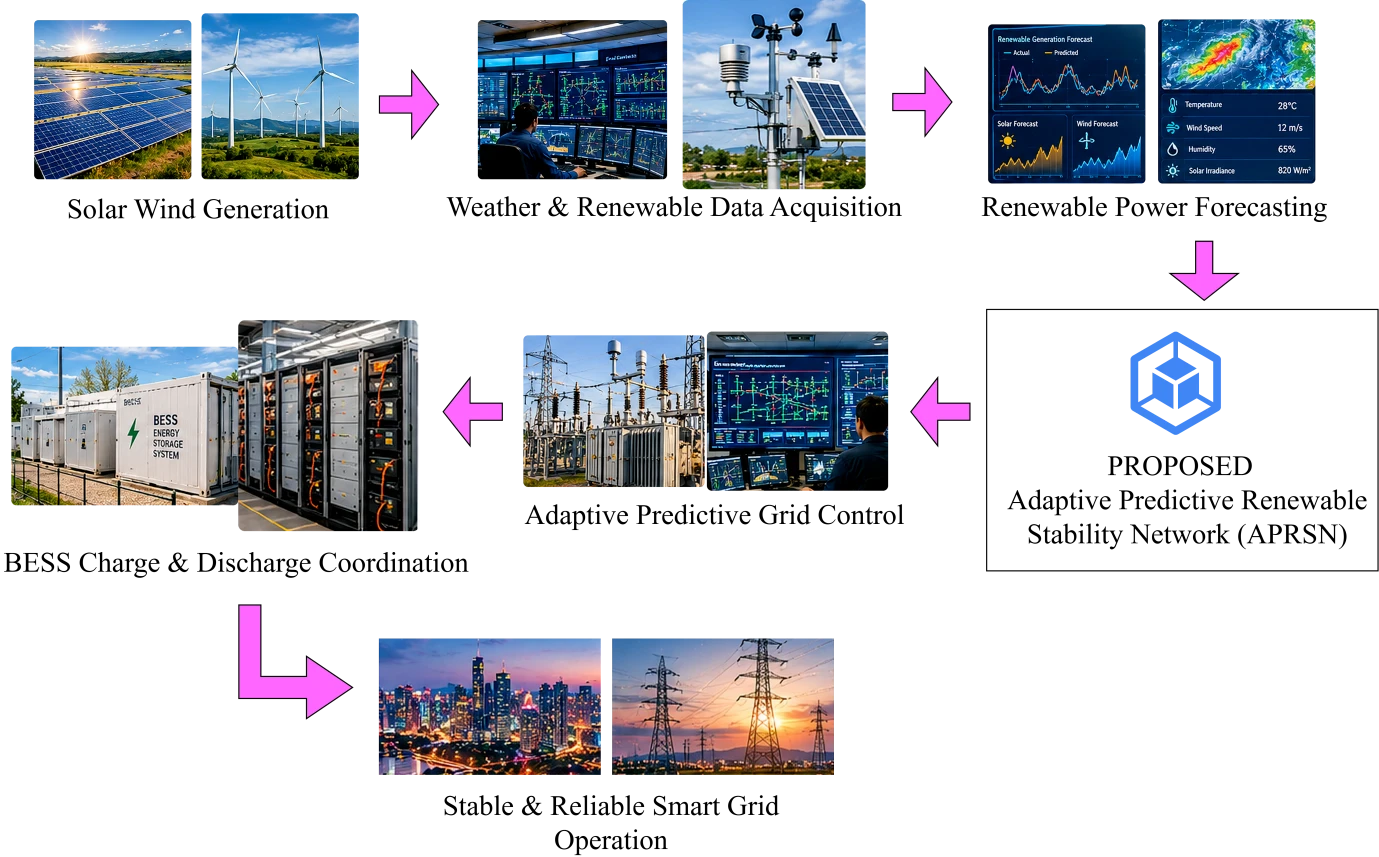
Graphical Abstract for Mitigating Renewable Power Fluctuations through Adaptive Predictive Control for Grid Stability Enhancement

References

[1]
Lv, X., Basem, A., Hasani, M., Sun, P., & Zhang, J. (2025). The potential of combined robust model predictive control and deep learning in enhancing control performance and adaptability in energy systems. Scientific Reports, 15(1), 11187. https://doi.org/10.1038/s41598-025-95636-0
[2]
Arafat, M. Y., Hossain, M. J., & Li, L. (2025). Advanced Deep Learning Based Predictive Maintenance of DC Microgrids: Correlative Analysis. Energies, 18(6), 1535. https://doi.org/10.3390/en18061535
[3]
Heidarykiany, R., & Ababei, C. (2025). Advanced day-ahead scheduling of HVAC demand response control using novel strategy of Q-learning, model predictive control and input convex neural networks. Energy and AI, 20, 100509. https://doi.org/10.1016/j.egyai.2025.100509
[4]
Saadati, T., & Barutcu, B. (2025). Forecasting solar energy: leveraging artificial intelligence and machine learning for sustainable energy solutions. Journal of Economic Surveys, 39(5), 1929–1946. https://doi.org/10.1111/joes.12678
[5]
Abdelsattar, M., Azim, M. A., AbdelMoety, A., & Emad-Eldeen, A. (2025). Comparative analysis of deep learning architectures in solar power prediction. Scientific Reports, 15(1), 31729. https://doi.org/10.1038/s41598-025-14908-x
[6]
Zournatzidou, G. (2025). Advancing Sustainability Through Machine Learning: Modeling and Forecasting Renewable Energy Consumption. Sustainability, 17(3), 1304. https://doi.org/10.3390/su17031304
[7]
Vijay Babu, R., Bharath Kumar, N., Patnaik Narasipuram, R., Periyannan, S., Hosseinpour, A., & Flah, A. (2025). Solar Energy Forecasting Using Machine Learning Techniques for Enhanced Grid Stability. IEEE Access, 13, 93735–93754. https://doi.org/10.1109/ACCESS.2025.3574093
[8]
Alaerjan, A., & Jabeur, R. (2025). An online learning method for assessing smart grid stability under dynamic perturbations. Scientific Reports, 15, 10559. https://doi.org/10.1038/s41598-025-94718-3
[9]
Javed, H., Eid, F., El-Sappagh, S., & Abuhmed, T. (2025). Sustainable energy management in the AI era: a comprehensive analysis of ML and DL approaches. Computing, 107(6), 132. https://doi.org/10.1007/s00607-025-01485-0
[10]
Anonto, H. Z., Hossain, M. I., Shufian, A., Sayem, M. S., Shovon, S. T. H., Sheikh, P. P., & Alam, S. S. (2025). Intelligent energy management of microgrids using machine learning: Leveraging random forest models for solar and wind power. Results in Engineering, 106539. https://doi.org/10.1016/j.rineng.2025.106539
[11]
Yameen, M. Z., Lu, Z., El-Sousy, F. F., Younis, W., Zardari, B. A., & Junejo, A. K. (2025). Improving frequency stability in grid-forming inverters with adaptive model predictive control and novel COA-jDE optimized reinforcement learning. Scientific Reports, 15(1), 16540. https://doi.org/10.1038/s41598-025-00896-5
[12]
Shaik, S., & Luedke, R. G. (2025). AI-Driven Predictive Control for Renewable-Integrated Smart Grids: Toward Enhanced Stability and Efficiency. National Journal of Intelligent Power Systems and Technology, 1(2), 44–51. https://doi.org/10.17051/NJIPST/01.02.06
[13]
Talaat, F. M., Kabeel, A. E., & Shaban, W. M. (2025). Powering a sustainable future: AI-driven integration of renewables for optimized grid management. Sustainable Futures, 10, 100821. https://doi.org/10.1016/j.sftr.2025.100821
[14]
El-Hameed, M. A., Saeed, M., Kabbani, A., & Abd El-Hay, E. (2025). Efficient load frequency controller for a power system comprising renewable resources based on deep reinforcement learning. Scientific Reports, 15(1), 18379. https://doi.org/10.1038/s41598-025-03310-2
[15]
Singh, A. R., Sujatha, M. S., Kadu, A. D., Bajaj, M., Addis, H. K., & Sarada, K. (2025). A deep learning and IoT-driven framework for real-time adaptive resource allocation and grid optimization in smart energy systems. Scientific reports, 15(1), 19309. https://doi.org/10.1038/s41598-025-02649-w
[16]
Zhang, Q., Jia, Q., Zhang, T., et al. (2025). An Artificial Intelligence Frequency Regulation Strategy for Renewable Energy Grids Based on Hybrid Energy Storage. Energies, 18(10), 2629. https://doi.org/10.3390/en18102629
[17]
Efatinasab, E., Brighente, A., Donadel, D., Conti, M., & Rampazzo, M. (2025). Towards robust stability prediction in smart grids: GAN-based approach under data constraints and adversarial challenges. Internet of Things, 33, 101662. https://doi.org/10.1016/j.iot.2025.101662
[18]
Su, H.-Y., & Lai, C.-C. (2025). Improving Online Voltage Stability Monitoring in Smart Grids: A Physics-Informed Guided Deep Learning Model. IEEE Transactions on Industry Applications, 61(2), 2397–2409. https://doi.org/10.1109/TIA.2025.3529813
[19]
Rashid, T. S., Refat, K. A., Islam, M. N., et al. (2025). Machine learning-driven PV forecasting and coordinated PV–BESS dispatch for optimizing distribution grid performance under high EV penetration. Energy Conversion and Management: X, 101418. https://doi.org/10.1016/j.ecmx.2025.101418
[20]
Wang, B., Baziar, A., & Askari, M. R. (2025). A Deep Reinforcement Learning Framework for Adaptive Resiliency Enhancement in Smart Power Grids. IEEE Access, 13, 135420–135428. https://doi.org/10.1109/ACCESS.2025.3593903
[21]
Abbas, M., Che, Y., Maqsood, S., et al. (2025). Self-adaptive evolutionary neural networks for high-precision short-term electric load forecasting. Scientific Reports, 15, 21674. https://doi.org/10.1038/s41598-025-05918-w
[22]
Mamodiya, U., Kishor, I., Garine, R., et al. (2025). Artificial intelligence based hybrid solar energy systems with smart materials and adaptive photovoltaics for sustainable power generation. Scientific Reports, 15, 17370. https://doi.org/10.1038/s41598-025-01788-4
[23]
Ravivarma, K., Lokeshgupta, B., Udumula, R. R., et al. (2026). A comparative study of machine learning and deep learning models for renewable energy and load demand forecasting in smart microgrids. Discover Sustainability, 7, 518. https://doi.org/10.1007/s43621-026-02922-6
[24]
Rajak, M. K., & Pudur, R. (2025). Multiobjective adaptive predictive virtual synchronous generator control strategy for grid stability and renewable integration. Scientific Reports, 15, 9241. https://doi.org/10.1038/s41598-025-93721-y
[25]
Ayman, M., Attia, M. A., & Asim, A. M. (2026). An adaptive model predictive control approach for robust load frequency control under renewable energy disturbances. Scientific Reports, 16, 2607. https://doi.org/10.1038/s41598-025-33986-5
[26]
Lim, S., Lee, J., & Lee, S. (2025). Model Predictive Control-Based Energy Management System for Cooperative Optimization of Grid-Connected Microgrids. Energies, 18(7), 1696. https://doi.org/10.3390/en18071696
[27]
Patel, V. R., Cakar, H. S., & Jamil, M. (2026). Short-Term Solar and Wind Power Forecasting Using Machine Learning Algorithms for Microgrid Operation. Energies, 19(2), 550. https://doi.org/10.3390/en19020550
[28]
Yuan, Y., & Yang, Y. (2025). A State-of-Charge-Frequency Control Strategy for Grid-Forming Battery Energy Storage Systems in Black Start. Batteries, 11(8), 296. https://doi.org/10.3390/batteries11080296
[29]
García-Hoyos, M., Villena-Ruiz, R., Honrubia-Escribano, A., & Gómez-Lázaro, E. (2025). Stability Analysis of Electricity Grids with High Renewable Penetration Using a Grid-Forming Approach. Electronics, 14(24), 4871. https://doi.org/10.3390/electronics14244871
[30]
Ali, J. S., Qiblawey, Y., Alassi, A., Massoud, A. M., Muyeen, S. M., & Abu-Rub, H. (2025). Power System Stability With High Penetration of Renewable Energy Sources: Challenges, Assessment and Mitigation Strategies. IEEE Access, 13, 39912–39934. https://doi.org/10.1109/ACCESS.2025.3546491
Section
Articles